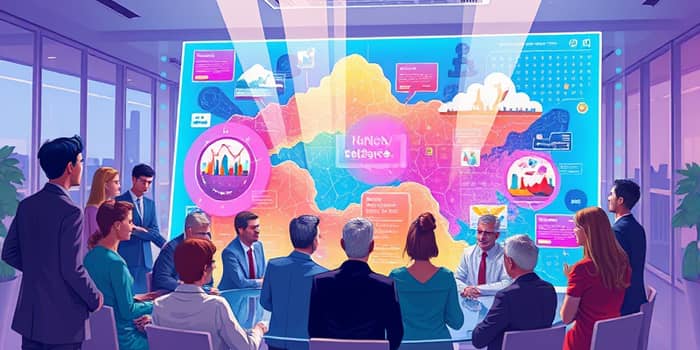
In an age where markets shift overnight and global events redefine the business landscape, organizations must build strategies that survive unexpected disruptions. By combining rigorous analysis with imaginative foresight, leaders can transform uncertainty into opportunity.
Two decades ago, companies typically planned five to ten years ahead. Today, planning horizons have shrunk dramatically, often to just months. The COVID-19 pandemic, geopolitical tensions, and climate disasters revealed the limitations of long-term forecasts.
Modern planners acknowledge that no single probable future can guide decision-making. Instead, they focus on a spectrum of plausible outcomes, maintaining agility and resilience.
Scenario planning is not about predicting the future—it’s about stress-testing strategies against diverse possibilities. By constructing multiple narratives, organizations can identify vulnerabilities and prepare adaptive responses.
Advances in big data, AI, and machine learning enable data-driven analysis and trend detection. These tools capture weak signals—subtle shifts that often precede major disruptions.
Organizations integrate quantitative forecasting with creative narrative work. They run war games and risk simulations to identify blind spots and refine plans continuously.
Resilience planning emphasizes flexibility. By adopting modular strategy architectures, organizations can swap or adjust strategic components as conditions evolve.
Continuous environmental scanning is essential. Organizations monitor leading metrics—regulatory signals, supply chain stresses, social sentiment—to detect emerging trends.
Dashboards visualize these indicators in real time, enabling teams to pivot swiftly when data suggests a scenario shift. Iterative review and adaptation become a core organizational rhythm.
Plans falter when they become rigid or overly reliant on intuition. To avoid common pitfalls, leaders should:
Transforming uncertainty into strategic advantage requires both mindset shifts and practical steps. Executives can begin by:
As volatility intensifies, organizations that master strategic foresight and scenario planning will lead their industries. By embracing multiple possible futures and building adaptive frameworks, teams can move confidently through uncertainty.
Ultimately, forecasting the future is less about crystal-ball predictions and more about cultivating a resilient, responsive culture. Leaders who weave foresight into their strategic fabric will not only survive disruption—they will thrive in it.
References